
Case for Support (online)
We are passionate about promoting play because it is essential in our lives. It underpins all development and learning for young children. We are helping families establish active lifestyles through taking part in outdoor activities and connecting with nature. This improves mental wellbeing, coronary and respiratory health, lowers obesity and reduces screen time for children, at a time where play is becoming increasingly digitalised.
Children play because it is an intrinsic and universal part of development (it’s not just humans either but shared across all mammals) Play arises naturally, driven not by instruction or reward, but by an inner motivation to explore, connect, and grow.
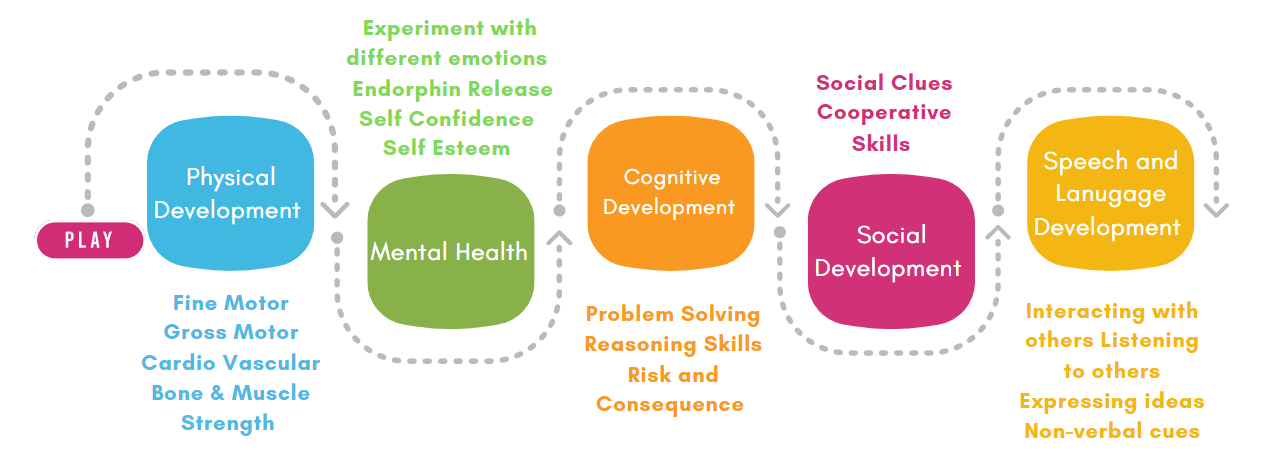
Play is how children learn about themselves and the world around them. Play develops children's understanding of their likes and dislikes, play is fun, play develops children to take risks (jumping down from a low wall or jumping into puddles), develops confidence and self esteem (who am I?), supports the development of being able to regulate emotions (turn taking and sharing eventually), learn social skills such as sharing, turn taking, language and communication skills, create friendships, understanding of the world around them (wood land wandering/ bugs hunting), learn communication skills such as observing other children and adults body language (talking signs) .Play supports children’s understanding, i.e. when a child physically does something e.g. planting seeds, rather than watching videos of how to plant a seed. The child will then have a better understanding by creating memories and physically planting a seed and developing their social skills by planting seeds.
Physical Development
Mental Health
Cognitive Development
Social Development
Speech and Language Development
The activities are also developed to promote what the Early Years Foundation Stage (EYFS) calls the characteristics of effective learning for young children, which are:
- Playing and Exploring: children investigate and experience things, and ‘have a go’.
- Active Learning: children concentrate and keep on trying if they encounter difficulties, and enjoy achievements.
- Creating and Thinking Critically: children have and develop their own ideas, make links between ideas, and develop strategies for doing things.

Our Solution
Parents are their child’s ‘first teacher’
Families have a significant influence on their child’s development and subsequently, their academic success, which directly influences the child’s life chances. Research consistently demonstrates this pivotal role of interactions between parent and child, yet, many families feel judged by professionals and services, and lack the self-esteem and confidence to engage in developmental activities with their children.
Early identification and intervention is the key to helping these issues, which is why 50 Things to Do is perfectly placed as the targeted, universal offer to improve life chances for young children.
Having fun together!
Our initiative is underpinned by evidence-informed impactful pedagogies and parenting approaches, but what parents really need to know is that it is full of fun stuff to do with their children! Our focus on families having fun together is a deliberate approach, promoting an inclusive, non-judgmental way for parents to engage fully with their children.
Even just a few minutes a day of playing together:
- creates relaxing and enjoyable times for children and adults, impacting positively on the whole family’s mental health.
- provides the ideal bonding opportunity, which helps to secure relationships.
Families and professionals working with young children play a vital role in supporting children to be confident communicators and when you embed 50 Things to Do Before You’re Five into your play, you are providing fun experiences which help to support children’s language development, mental health, cognitive development, physical development, social development and this can help improve parental confidence.
Promoting Play
We are passionate about promoting play because it is essential in our lives. It underpins all development and learning for young children. We are helping families establish active lifestyles through taking part in outdoor activities and connecting with nature. This improves mental wellbeing, coronary and respiratory health, lowers obesity and reduces screen time for children, at a time where play is becoming increasingly digitalised.
The Problem
Across the UK, young children's health and development is getting worse. Increasingly, we are seeing more children arriving at early years settings under developed and not prepared for learning. Currently, there is a crisis of children who are not ‘school ready’, there needs to be strategic intervention in order to mitigate against the growing number of children who are under developed as they enter education. The Guardian has commented that “While nine out of 10 parents thought their child was ready for school, primary school teachers said that only one in three children had the necessary skills.”
But, just how bad is the problem?

4 in 10 children are an unhealthy weight

A report published in 2020 by The Royal Foundation highlighted that 7 out of every 10 parents feel judged by others. Among these parents, almost half felt this negatively impacts their mental health.

1 in 5 children struggle with mental health

50% of children aged 3-4 spend about 9 hours a week online, stopping them from having beneficial time spent outdoors.

Currently in the UK 1.9 million children are struggling with talking and understanding words (Speech and Language UK). Around 50% of children who live in areas of social disadvantage starting school with language delay (Bercow - 10 years on).

A growing number of studies are finding associations between parental phone use and children’s language development (Miriam Mikhelson and Kaya de Barbaro - University of Texas at Austin).

33% of children do not play outside after school, at all. Children today spend 50% less time playing outdoors than any other generation.
Home Learning Environment
At 50 Things to Do Before You’re Five, we are helping families to make their home a great place to play and learn, supporting children’s development and contributing to improved life chances.
Why We Are Working to Reduce Screen Time for Families
Now more than ever, we are seeing more families using screens for entertainment instead of playing together. We encourage children and their parents to go play outdoors and explore their local communities, to reduce passive screen time.
Researchers say the decline in hands on activities - like crafting, outdoor play and puzzles has been being supplemented for screen time for years. With screens replacing traditional playtime, children are missing out on crucial movements that develop their dexterity, patience and focus.